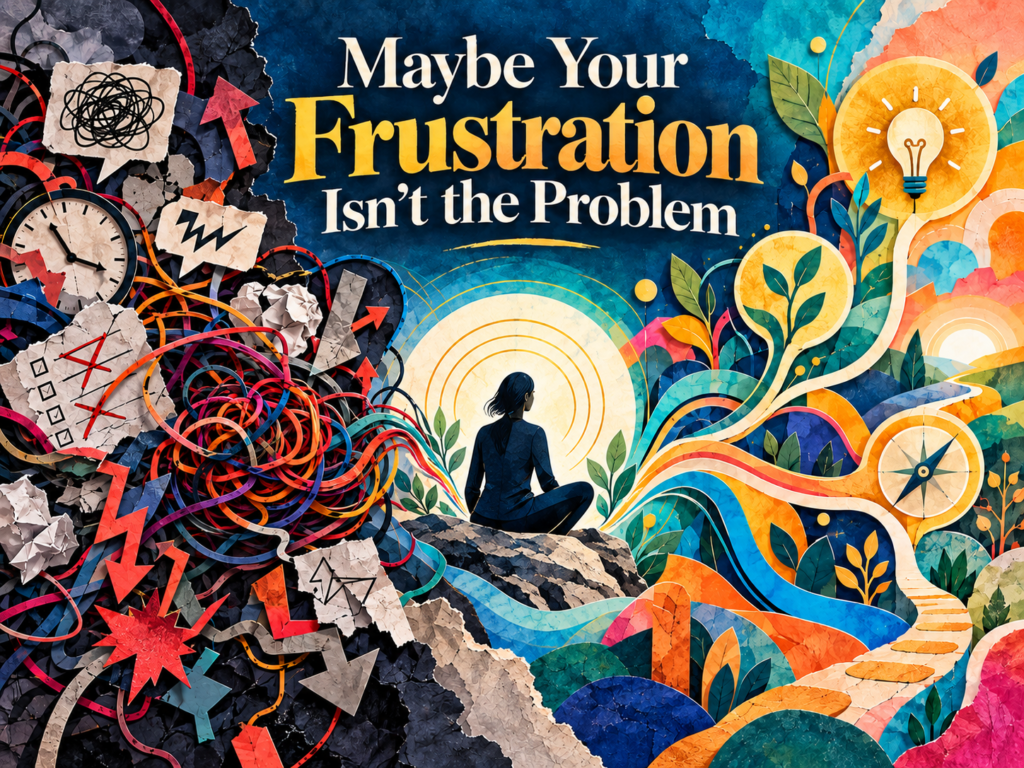

There are moments in life when something goes sideways and our first reaction is filled with frustration, disappointment, irritation, confusion, or self-doubt.
The plan didn’t work. The person disappointed us. The timing was off. The money feels wasted. The opportunity seemed promising, and then it fell apart. And because most of us have been trained to see life through the lens of logic, control, and problem-solving, we immediately start asking the usual questions.
What went wrong?
Why did this happen?
How do I fix it?
How do I make sure this never happens again?
Those are not bad questions. Sometimes they are necessary. But they are not always the best questions. Sometimes what looks like a problem is not only a problem. Sometimes it is a pattern being interrupted. Sometimes frustration is not just frustration. Sometimes it is life trying to move us out of an old way of seeing, thinking, and doing.
When a Problem Is More Than a Problem
I was reminded of this during a recent coaching conversation. The conversation started with a very practical problem. Something had not worked out the way my client expected. Time had been spent. Money had been spent. Energy had been spent. And the first instinct was to look at the situation through the very human lens of frustration.
But as we talked, something shifted.
The issue was not only about what had gone wrong. It became clear that the frustration was pointing to something much bigger. It was asking for a new way of thinking. A new way of creating. A new way of approaching the next stage of his life and work.
And that is where the real wisdom was.
The Limitation of the Logical Mind
Most of us are very comfortable using the left-brain part of ourselves. We know how to plan, organize, analyze, strategize, compare, evaluate, and control. We know how to make lists. We know how to look at what has been done before and try to do it a little better.
There is nothing wrong with this. In many ways, my logical mind has served me very well in my life. It has helped me build, lead, solve problems, make decisions, and navigate the practical side of being human. The logical mind is incredibly useful. I am not suggesting we abandon it and float through life waiting for some magical inspiration to land in our lap.
But the logical mind has one major limitation.
It mostly knows what it already knows.
It looks at the past. It studies what has worked before. It tries to protect us from making mistakes. It wants certainty before movement. It wants proof before trust. It wants the steps laid out before the journey begins.
That’s helpful when we are doing our taxes, booking an appointment, building a system, or making sure the bills are paid.
But it is not where our deepest creativity comes from.
Our best ideas rarely come when we are squeezing the mind harder. They come when something in us softens enough to see differently. They come when we stop forcing the old answer and make room for a new one. They come when we reconnect with the creative intelligence within us.
This creative intelligence is not only for artists, musicians, writers, or inventors. It is not reserved for people who paint, perform, compose, or build beautiful things. It is part of being human.
It is the part of you that sees possibility where the mind sees only a problem.
It is the part of you that senses a new direction before you can explain it.
It is the part of you that says, “Maybe there is another way.”
It is the part of you that can turn an interruption into an opening.
During that conversation, my client used a phrase I loved. He talked about “feeding the muse.” I smiled when I heard it because it gave language to something I have been learning in my own life.
The muse is not some mysterious being that only visits poets in candlelit rooms. At least, that is not how I see it. To me, the muse is the creative part of us that needs to be honoured, listened to, and invited into the process. It is the intuitive mind. The deeper knowing. The Soul-led imagination. The inner wisdom beneath the thinking mind.
But here is the problem.
Most of us do not feed the muse.
We feed the worry. We feed the pressure. We feed the overthinking. We feed the old story.
We feed the belief that everything has to make sense before we begin.
And then we wonder why we feel blocked, frustrated, uninspired, or stuck.
When an Old Story Closes the Door
I have seen this in my own life. For a long time, if someone had asked me whether I would write another book, I probably would have said no. Not because I had nothing to say. I have plenty to say. Sometimes too much, if you ask my wife.
The deeper issue was that I still had an old story about writing.
I did not see myself as a great writer. My previous experience co-authoring a book had been meaningful, but it was also difficult. So somewhere in my mind, the conclusion became, “I don’t write well enough to do this again.”
That was the left brain speaking.
It had evidence. It had history. It had a conclusion. It had built a case.
But then something started to shift.
I began working with AI in a way that felt less like replacing my creativity and more like supporting it. I started to see it as a companion in the creative process. Not the source of the wisdom. Not the one leading the way. More like a helper that could organize my thoughts, challenge me, reflect things back, and help shape what was already inside me.
That changed everything.
Suddenly the question was no longer, “Can I write a book the old way?”
The question became, “What if there is a new way for this book to come through me?”
That is a very different question.
One question shuts the door. The other opens it.
And that is often how creative intelligence works. It does not always give us a complete answer. Sometimes it simply invites us to ask a better question.
Sometimes the Feeling Is the Signal
This is where frustration can become so useful.
Frustration is uncomfortable, but it is not useless. Neither is disappointment, irritation, confusion, boredom, or feeling stuck. These lower and slower emotions often show up when something in us is contracted. We are trying too hard to make life fit the old pattern. We are pushing from the mind instead of listening from a deeper place.
The emotion is not always the enemy. Sometimes it is the signal.
Frustration may be saying, “You are trying to force something that wants to evolve.”
Confusion may be saying, “You are not meant to understand this only from the mind.”
Boredom may be saying, “Your Soul is craving more life.”
Irritation may be saying, “You are resisting a truth you already know.”
Feeling stuck may be saying, “The old way has taken you as far as it can.”
That does not mean every unpleasant feeling is some grand spiritual message. Sometimes we are just tired, hungry, overwhelmed, or dealing with difficult people. Let’s not over-spiritualize everything.
But it does mean we can become more curious.
Instead of immediately asking, “How do I get rid of this feeling?” we might ask, “What is this feeling trying to show me?”
That question alone can shift us from reaction into creativity.

I loved the image that came up in the conversation of a painter accidentally spilling paint on a canvas. The logical mind immediately says, “I ruined it.” It sees the accident. It sees the disruption. It sees the loss of control.
But someone else walks into the room and says, “That is incredible, what a masterpiece.”
Same canvas. Different perception.
The accident did not change. The way it was seen changed.
This is such a powerful metaphor for life. How often do we look at something unexpected and immediately label it as wrong, inconvenient, wasteful, or failed? How often do we assume the plan was interrupted instead of considering that maybe something new is trying to emerge through the interruption?
The creative genius within us does not always work in straight lines. It often works through detours, mistakes, timing shifts, strange conversations, unexpected tools, and experiences we would never have chosen with the logical mind.
That is why we need both parts of ourselves.
We need the mind that can build the bridge.
But we also need the inner vision that can imagine a bridge where no bridge exists yet.
We need structure, but not so much structure that inspiration cannot breathe.
We need tools, but we cannot let the tools become the source of our wisdom.
We need technology, systems, support, assistants, calendars, websites, and practical implementation. But those things should serve the creative intelligence, not replace it.
Let the Muse Lead and the Mule Carry
I said something in that coaching conversation that has stayed with me. When it comes to AI and other tools, I said, “I am the muse, and I want it to be the mule.”
That may sound funny, but I actually think there is a lot of truth in it.
The muse is the part of us that receives the inspiration. The mule carries the load. The muse sees the possibility. The mule helps bring it into form. The muse dreams, senses, feels, imagines, and creates. The mule organizes, structures, edits, schedules, researches, and implements.
The problem comes when we ask the mule to be the muse.
That is when life starts to feel hollow.
We can use all the tools in the world and still feel disconnected if we are not bringing our own Soul, wisdom, presence, and discernment into the process. Innovation is not about letting tools think for us. It is about allowing the creative part of us to lead, and then using whatever practical support is available to help bring the vision into reality.
This is true whether you are writing a book, growing a business, healing a relationship, creating a course, solving a family problem, or trying to understand the next stage of your life.
The deeper question is not only, “What should I do?”
The deeper question is, “What part of me is leading?”
Is it fear?
Is it pressure?
Is it old conditioning?
Is it the need to control?
Is it the belief that I have to do this the way it has always been done?
Or is it the deeper creative intelligence within me — the part that can see beyond the obvious?
The Creative Process Begins with Noticing
I am learning that when something frustrates me, I do not always need to rush to fix it. Sometimes I need to pause long enough to listen differently. I need to ask whether life is blocking me, or whether life is redirecting me. I need to ask whether the problem is really a problem, or whether it is an invitation to move beyond an old way of thinking.
This does not mean I always do it gracefully. I still get annoyed. I still overthink. I still try to control things that clearly have no interest in being controlled. I still sometimes need the Universe to repeat the lesson a few times before I finally get the message.
But I am getting better at noticing.
And maybe that is where the creative process begins.
Not with a perfect idea.
Not with a flawless plan.
Not with total confidence.
But with noticing.
Noticing when the old way feels too tight.
Noticing when frustration is asking for curiosity.
Noticing when your thinking mind has reached its limit.
Noticing when something deeper in you is ready to participate.
The creative genius within you does not need you to abandon logic. It needs you to stop worshipping it.
Your mind is a beautiful servant, but it was never meant to be the only guide.
There is another intelligence within you. A wiser, more spacious, more imaginative part of you. It speaks through inspiration. It speaks through discomfort. It speaks through longing. It speaks through the quiet nudge that says, “There may be another way.”
Activate the Wisdom
The next time something does not go according to plan, pause before calling it a failure.
Notice your first interpretation. Is your mind immediately deciding that something has gone wrong, that time has been wasted, or that the experience should not have happened?
Then ask yourself:
“What else might this situation be showing me?”
“Am I trying to solve this only with what I already know?”
“Is frustration asking me to force harder, or to see differently?”
“What old belief, method, or expectation may have taken me as far as it can?”
“What possibility becomes visible when I stop insisting that the original plan must work?”
You might also reflect on the relationship between your muse and your mule.
What part of your life requires your creativity, intuition, imagination, or deeper wisdom to lead?
What practical tool, system, person, or form of support could help carry the vision without replacing your own inner authority?
Choose one current frustration and write down three possible interpretations of it.
The first can be the interpretation your thinking mind has already created.
The second can be a more compassionate interpretation.
The third can be the most creative or unexpected possibility you can imagine.
You do not need to force yourself to believe the third interpretation. The purpose is simply to loosen the grip of the first one and create space for another form of intelligence to participate.
Maybe the spilled paint is not the end of the painting.
Maybe the frustration is not here to punish you.
Maybe the old plan had to crack so something more creative could come through.
Your mind is a beautiful servant, but it was never meant to be your only guide.
June 6, 2026