From a young age, I learned that being responsible meant doing what was right, meeting my obligations, looking after the people I loved and being someone others could depend on. I also learned the importance of kindness, generosity and being there for others when they needed me. Over time, these values became deeply ingrained in how I believed I should live my life.
Those seem like good qualities to have. And they are. Yet I’ve discovered that even qualities we admire can sometimes leave us struggling inside.
There have been times when my responsibility told me I had to keep going, while my kindness told me I couldn’t let someone down. Meanwhile, another part of me was exhausted and quietly asking for some space.
I didn’t always recognize that as an inner conflict. I just noticed myself becoming frustrated, impatient, sometimes downright argumentative. I have a phrase for it: my love tank is running dry.
For years, my instinct was to push harder, fix the situation or try to work out who was being unreasonable. It took me a long time to recognize that the real struggle was often happening within me.
When Good Values Pull Us in Different Directions
Responsibility and kindness aren’t enemies. But the beliefs we’ve developed about what they require of us can make them feel that way.
If I believe being responsible means I must carry everything, I can resent anyone who doesn’t carry as much. If I believe kindness means always putting others first, I can feel guilty when I want to say no.
Suddenly, I’m caught between two versions of the person I think I should be.
One of Shaltazar’s teachings that has helped me understand this is that our qualities, behaviours and ways of expressing ourselves exist on a continuum. We can express responsibility wisely or take it so far that it becomes control. We can offer kindness generously or extend it to others while neglecting ourselves.
It isn’t the value that needs to be discarded. It’s how I’m interpreting and expressing it that may need to change.
And what is appropriate in one situation may not be appropriate in another. There isn’t one permanent setting for kindness or responsibility that works for every circumstance.
That’s where discernment enters. Can I pause long enough to ask what this moment calls for, rather than automatically responding as I always have?
Life on the Tightrope
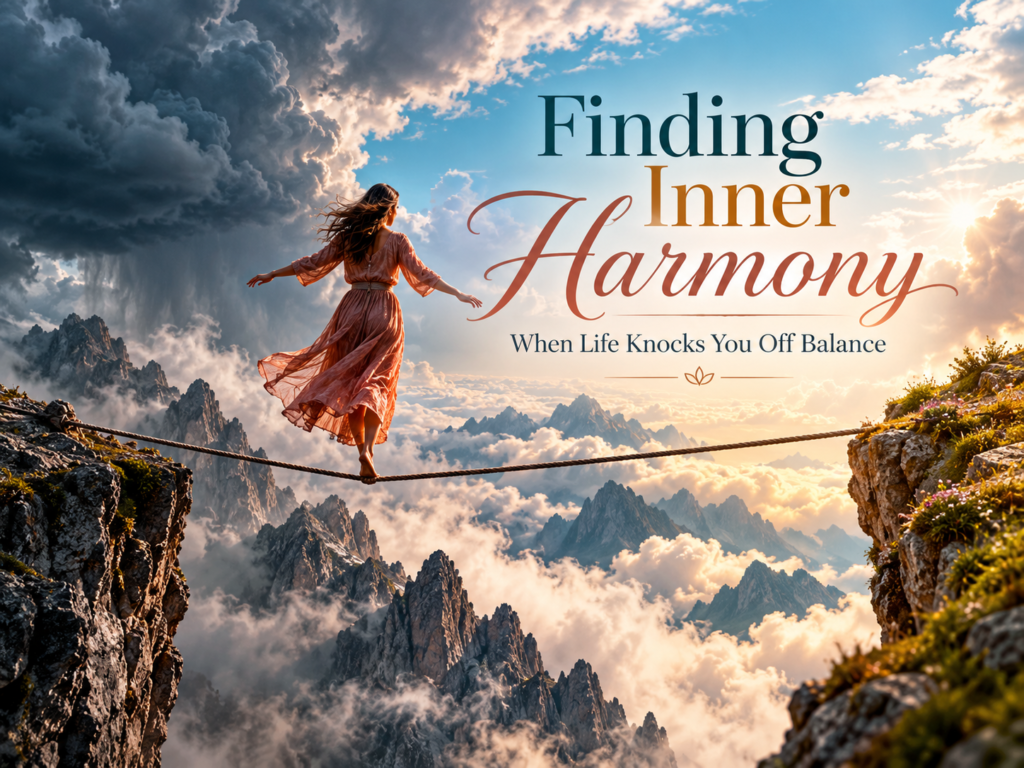
I sometimes imagine life as walking a tightrope.
We’re continually adjusting our weight, leaning this way and that, trying to stay upright. Just when we think we’ve found our balance, life changes. A relationship needs attention. Someone asks more of us. Our circumstances shift. What worked yesterday no longer works today.
Shaltazar has taught me to see balance as something continually moving, rather than a fixed state we finally achieve.
The difficulty is that I can treat losing my balance as a personal failure. I should have known better. I should be more patient. After all these years of spiritual growth, shouldn’t I have this figured out?
Those judgments don’t restore my balance. They just add another burden.
And there’s something else I’m beginning to understand: I don’t have to scramble back onto the tightrope the instant I fall.
The fall may have something to teach me.
Maybe I’ve been carrying too much. Maybe I’ve ignored a feeling because I didn’t want to disappoint someone. Maybe I’ve been defining my worth by how much I accomplish.
If I rush to feel peaceful again, I may miss the opportunity to learn what brought me here.

What My Empty Love Tank Tells Me
When I finally recognize that my love tank is running dry, I’ve learned to look beyond what’s frustrating me and become curious about what’s happening within me.
Often, the love that’s missing is the love I haven’t been extending to myself. I’ve been so occupied with meeting expectations, being useful or doing the right thing that I’ve forgotten to offer myself the patience and compassion I readily offer others.
In the past, that realization could become another reason to criticize myself. Now I try to ask different questions.
What am I expecting of myself? What part of me feels unheard? Have my beliefs about being responsible, kind or good enough become too rigid?
I don’t always find answers straight away. Sometimes I need to sit with the discomfort, listen to my feelings and give myself permission not to solve everything today.
Perhaps that’s where inner harmony begins—not by immediately restoring my balance, but by learning to treat myself more lovingly while I’m finding my way.
Harmony Isn’t the Same as Having Everything Sorted Out
I used to imagine inner harmony as a beautiful state in which all the different parts of me finally agreed and life felt peaceful.
I’m discovering something less perfect and far more useful.
Inner peace is not necessarily the absence of inner conflict. Inner harmony is the ability to remain in a loving relationship with ourselves even when that conflict exists.
I can value kindness and still need a boundary. I can value responsibility and still need rest. I can make a difficult choice without making the part of me that wishes things were different into an enemy.
Sometimes two needs can’t both be fully satisfied. Harmony doesn’t magically remove that difficulty. It allows me to listen to both with respect, use discernment and choose without turning the decision into a verdict on my worth.
The same applies when I get it wrong. I can acknowledge where I was impatient or unkind, make amends where needed and learn from the experience, without deciding that I am a failure.
Learning to Walk Again
The next time you notice your own love tank running dry, or feel torn between two things that matter to you, perhaps you don’t need to force an immediate solution.
Notice what you’re feeling. Ask which values or expectations may be pulling you in different directions. Consider whether there is another way to express those values that includes your own well-being.
And if you’ve fallen off the tightrope, allow yourself a moment on the ground. You might discover something there that you couldn’t see while concentrating so hard on staying upright.
We are not meant to finish learning, stop changing or maintain perfect balance. We are living, experiencing and continually discovering how to meet life as it unfolds.
Perhaps the greatest expression of inner harmony isn’t how gracefully we maintain our balance, but how lovingly we treat ourselves when we lose it.