Have you ever stopped to wonder how much of what you believe about yourself, other people, and the world is actually your own truth?
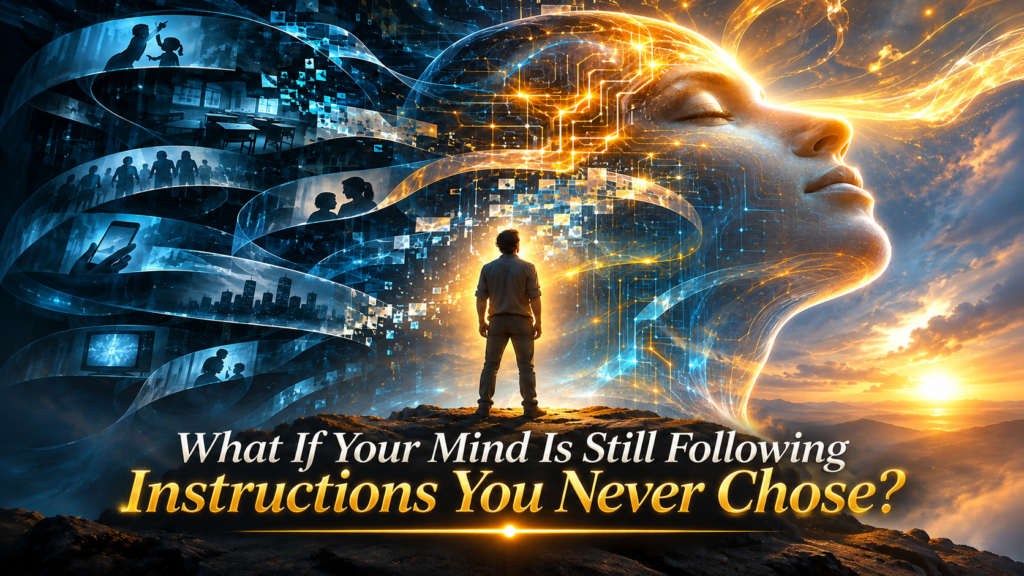
What if the beliefs guiding your decisions, shaping your fears, influencing your relationships, and determining what you think is possible were never consciously chosen by you?
What if you simply learned them?
We spend so much of our lives trying to change what we’re experiencing without questioning the inner programming that’s shaping how we experience it.
We try to become more confident, less anxious, more successful, or more fulfilled. We work on improving our circumstances and overcoming recurring challenges. But how often do we consider that some of the beliefs we hold may be preventing us from experiencing the very changes we’re seeking?
Perhaps some of the changes we’re searching for on the outside begin with questioning what we’ve accepted as truth on the inside.
The Programming We Never Knew We Were Receiving
From the moment we’re born, we begin absorbing information about how life works.
Our parents teach us what’s acceptable. Schools teach us what success looks like. Society teaches us what we should value and how we should behave. We learn what makes us worthy of approval, what might cause rejection, what’s safe, and what’s dangerous, often long before we’re able to question any of it.
Most of what we’re taught comes from people who genuinely want the best for us. They’re sharing what they believe to be true, often based on the programming they received themselves.
This isn’t about blame or deciding what’s right or wrong.
It’s about recognizing that someone else’s truth can become our truth without us ever consciously choosing it.
And once those beliefs become familiar, they simply become the way life is.
What If Your Mind Works a Little Like a Computer?
Think about how a computer works. It follows programmed instructions, and sometimes one small piece of incorrect code can affect several different functions. Rather than trying to fix each problem individually, a programmer looks for the underlying code responsible for them. Once that code is corrected, each of the affected functions can be tested to see if the problems have been resolved.
I believe something similar happens in our lives. Imagine growing up believing that making mistakes means you’re not good enough.
That belief might create perfectionism at work, insecurity in relationships, and fear of failure when considering new opportunities.
Three seemingly different challenges, yet all may be influenced by the same underlying belief.
We often try to solve each problem separately without recognizing the programming connecting them.
And here’s something even more fascinating.
We can become so accustomed to our programming that we mistake it for our personality.
We say, “I’ve always been anxious,” “I’m just not confident,” or “I’ve never been good at relationships.”
But are these qualities who we truly are, or are they patterns we’ve learned through our experiences?
When Protection Becomes Limitation
Not all our programming comes from what people tell us. Some develops through what we experience.
Perhaps you were embarrassed when you spoke up as a child, so you learned that remaining quiet was safer.
Maybe someone betrayed your trust, and you began believing that opening your heart was dangerous.
At the time, those responses may have made perfect sense. Your mind was trying to protect you.
But what happens when those protective patterns continue operating long after the circumstances have changed?
A belief that once helped you feel safe may now be limiting your life. And because the programming has become so familiar, you may not realize you have another choice.
Sometimes we’re not responding to the life we’re living today. We’re responding to what we learned about life yesterday.
The World Is Still Programming Us
The programming doesn’t stop when we become adults. Social media algorithms influence what we see. Advertising shapes what we desire. News and political messaging can influence what we fear and how we interpret the world.
And the more often we encounter a particular perspective, the more convincing it can become.
How much of this information are we consciously evaluating, and how much are we absorbing without realizing it?
Curiosity and openness are essential to growth, but there’s a difference between being open to new ideas and unconsciously adopting them as our beliefs.
Being informed isn’t necessarily the same as being aware.
What If Our Limitations Are Part of the Opportunity?
There’s a spiritual dimension to all of this that I find particularly meaningful.
I believe we are spiritual beings having a human experience, and that part of our purpose is to experience the limitations of being human.
We enter a world of duality, where we encounter fear and love, separation and connection, uncertainty and trust.
But what if those limitations aren’t simply obstacles to overcome? What if they provide the very opportunities through which we can awaken to a deeper understanding of who we are?
Perhaps the purpose isn’t to avoid being conditioned by life. That would be almost impossible.
Perhaps the opportunity lies in becoming aware of our conditioning and discovering that we don’t have to remain confined by it.
Shaltazar often reminds us that the mind is an extraordinary part of our human experience. We’re not here to reject it or defeat it. We’re here to learn how to make it our ally.
And that begins with awareness.
Finding Our Own Truth
So how do we begin changing our programming?
Not by declaring everything we’ve learned is wrong or forcing ourselves to think positively.
We begin by becoming curious.
When a familiar fear arises, we might ask, “What am I believing right now, and where did that belief come from?”
When we react strongly to something, we might wonder, “Am I responding to what’s happening, or to something this reminds me of?”
When we tell ourselves something isn’t possible, we might ask, “How do I know that’s true?”
These questions create space to observe rather than automatically react, to consider another perspective, and to discover that what we’ve always believed may not be the only way of understanding life.
Changing deeply established patterns takes patience. Once we recognize a belief that no longer serves us, we can begin exploring a different one that feels both empowering and believable. Through repetition and new experiences, we gradually give that new belief greater influence over how we live.
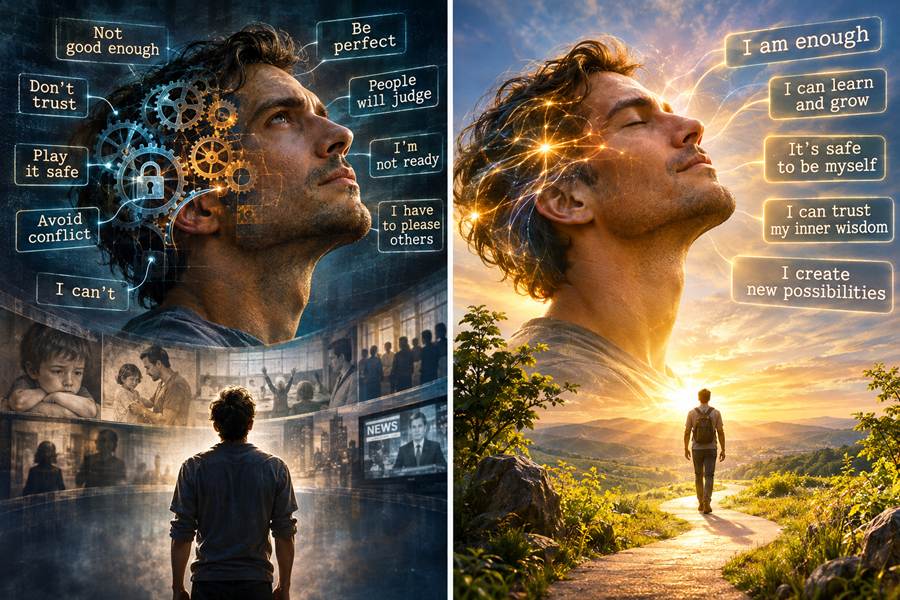
The goal isn’t to replace one set of unquestioned instructions with another. It’s to become increasingly conscious of the beliefs we choose to live by.
Perhaps Awakening Begins with a Question
Imagine learning that you can respect another person’s truth without having to adopt it as your own.
That you can acknowledge your past without allowing it to determine your future.
That you can change your mind without betraying who you are.
In fact, perhaps changing your mind is sometimes how you begin discovering who you really are.
I don’t believe awakening is about arriving at a place where we finally have all the answers. I believe it’s about becoming increasingly willing to question what we think we know.
Perhaps that’s one of the greatest gifts of this human journey.
We experience the limitations of our conditioning, discover how those limitations have shaped our lives, and gradually recognize our freedom to choose something different.
The programming we received may have helped shape the person we’ve become. But awareness gives us the opportunity to consciously participate in who we’re becoming.
And that may be where true freedom begins.
A Moment for Reflection
Take a moment to consider:
- What belief about yourself have you accepted for so long that you’ve stopped questioning whether it’s true?
- Is there a recurring challenge in your life that might be connected to an underlying belief you’ve never examined?
- If you could set aside what others have taught you to believe, what might your own inner wisdom be telling you?
You don’t need the answers immediately. Sometimes simply asking a different question begins changing how we experience life.
One Small Step
Over the next few days, notice one recurring thought that limits what you believe is possible.
Rather than judging it or trying to replace it immediately, get curious.
Ask yourself, “Where did I learn to believe this? Is it necessarily true today? And what might become possible if I began seeing it differently?”
You may discover that what once seemed like an unquestionable truth is simply a familiar perspective.
And perspectives can change.